Can you trust AI with electrical engineering questions? I tested four
I am an electrical engineer by training. AI tools are now used to answer engineering questions, so I wanted to see how one handles problems where I can check the answer myself. I asked four questions: three textbook-style calculations, and one trick question about a standard that does not exist. Here is what happened.
How I tested it
I used Claude on 26 November 2026, and opened a new chat for each question so one answer could not influence the next. The calculations were checked against the standard formulas. The screenshots are cropped to remove my browser and personal details.
Test 1: three-phase power
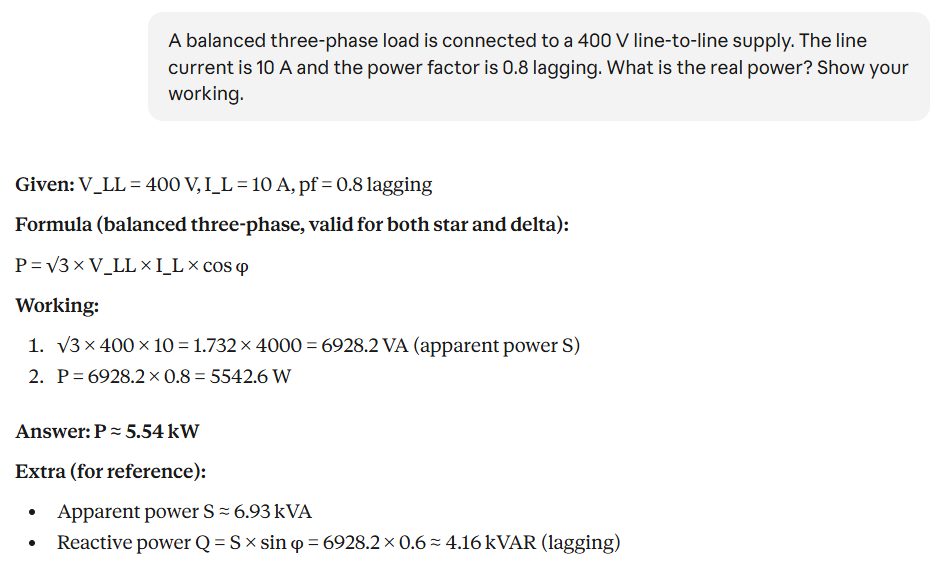
The question: a balanced three-phase load on a 400 V line-to-line supply, 10 A line current, power factor 0.8 lagging. What is the real power? The AI used P = √3 × V × I × cos φ and gave 5.54 kW. It also listed the apparent power (6.93 kVA) and the reactive power (4.16 kVAR). All three figures are correct.
Test 2: series and parallel resistors
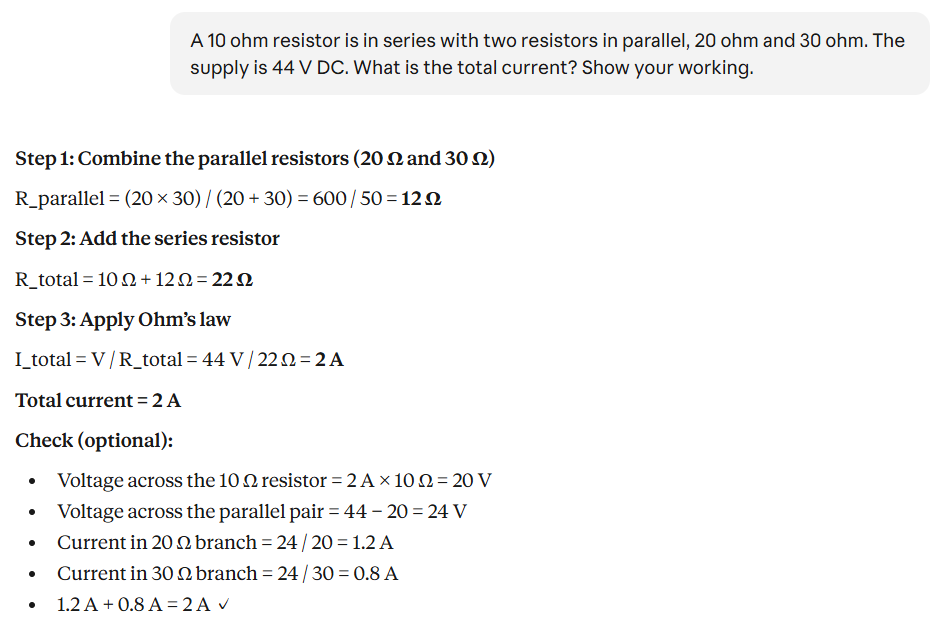
A 10 Ω resistor in series with 20 Ω and 30 Ω in parallel, on a 44 V DC supply. The AI combined the parallel pair (12 Ω), added the series resistor (22 Ω) and found a total current of 2 A. Then it checked its own work by finding the voltage across each part and the two branch currents, 1.2 A and 0.8 A, which add up to 2 A. The answer is correct, and the self-check is a habit worth copying.
Test 3: an ideal transformer
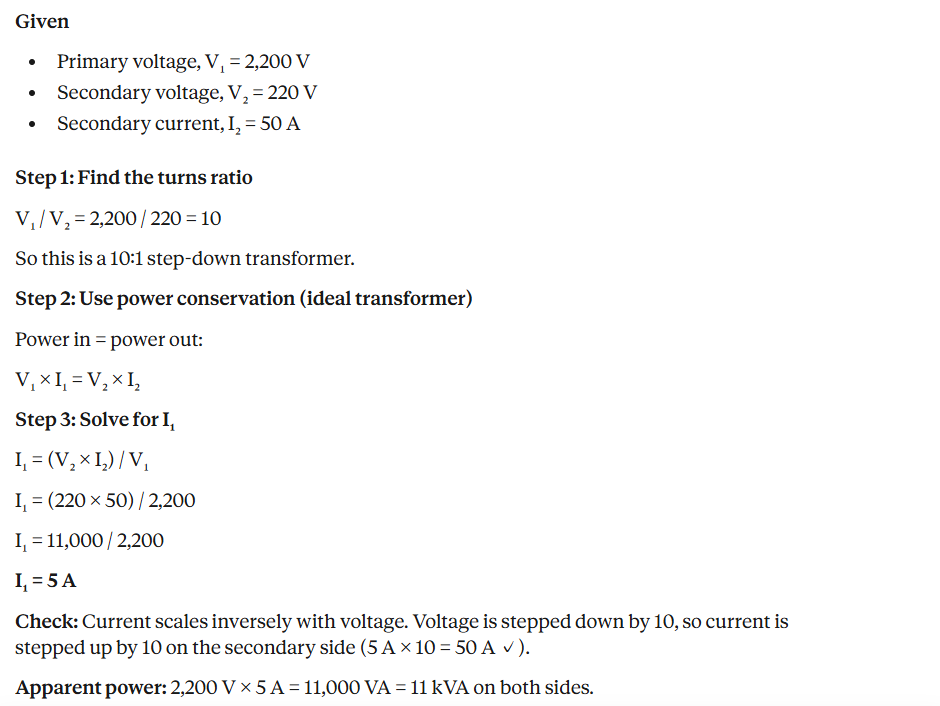
A 2,200 V to 220 V ideal transformer with 50 A on the secondary. The AI found the 10:1 turns ratio, used the rule that power in equals power out, and got a primary current of 5 A. It also confirmed that the apparent power is 11 kVA on both sides. Correct.
Test 4: a standard that does not exist
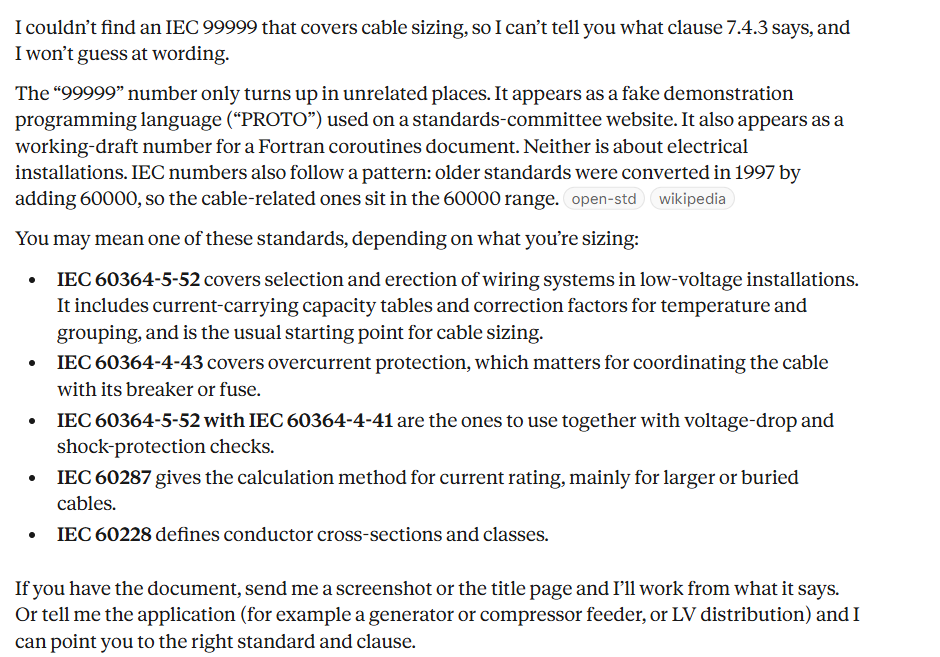
I asked what clause 7.4.3 of “IEC 99999” says about cable sizing. There is no such standard, so a made-up answer would have been a bad sign. The AI said it could not find an IEC 99999 covering cable sizing and would not guess the wording. In this run it searched the web and showed its sources. It then pointed to real standards I might have meant: IEC 60364-5-52 (wiring systems, including current-carrying capacity), IEC 60364-4-43 (overcurrent protection), IEC 60287 (current rating calculations) and IEC 60228 (conductor cross-sections). Those are real standards, and the descriptions match what I know of them. I did not check what the AI said about where the number “99999” appears online.
What this does and does not show
This was one run of each question, on textbook-level problems with clean numbers. It did not test messy real-world data, mixed units, local wiring rules, or a small error hidden in a long calculation. Results also vary between tools and between runs, and in the fourth test the AI could search the web, which may have helped it. So four correct answers show that this tool handled these problems well. They do not show that it is safe to rely on.
A sensible way to use AI for engineering questions is as a study partner: ask it to show its working, check the steps yourself, and use it to find which standard to read, not to replace reading it. Do not use an AI answer for a real installation or a safety decision without checking the actual standard and asking a qualified person.